The text message arrived at 8:12 on a Sunday morning.
Most people expect flowers, family photos, and warm wishes on Mother’s Day.
Instead, my mother sent me seven words that changed our family forever.
“We’re doing Mother’s Day with the well-behaved kids.”
Then came the sentence that hurt even more.
“Yours can skip this year.”
I stared at the screen.
Across the breakfast table, my eight-year-old daughter Lily was eating pancakes shaped like hearts.
She looked up immediately.
Children always know when something is wrong.
“What happened?” she asked.
“Nothing,” I lied.
But Lily had already seen my face.
A few moments later, she quietly lowered her eyes and whispered:
“Grandma doesn’t like me very much, does she?”
The question hit harder than the text.
Not because it was unexpected.
Because it was true.
For years I had watched subtle favoritism grow inside our family.
My brother’s children received expensive birthday gifts.
My sister’s children were included in every family vacation.
But Lily somehow always ended up on the outside.
Different.
Less important.
Less welcome.
And every time I noticed it, I convinced myself I was overreacting.
That morning I finally stopped lying to myself.
The exclusion wasn’t accidental.
It was intentional.
And for the first time, I decided not to protect the people hurting my daughter.
Instead, I opened my banking app.
The process took twenty-two minutes.
Twenty-two minutes to undo ten years of financial support.
Authorized credit card users removed.
Family phone plans transferred.
Streaming services canceled.
Automatic bill payments disabled.
Vacation memberships terminated.
Luxury shopping accounts disconnected.
No arguments.
No announcements.
No warnings.
Just silence.
The kind of silence that comes before a storm.
What nobody in my family seemed to remember was that I had quietly become the financial backbone of the entire operation.
Not because I inherited money.
Not because I married rich.
Because I built a successful financial consulting company from the ground up.
Over fifteen years, my business expanded from helping small clients manage retirement accounts to advising high-net-worth families on estate planning, investment strategies, trust management, and property ownership structures.
The income grew.
The company grew.
And somewhere along the way, I became the family safety net.
Every holiday gathering.
Every expensive dinner.
Every emergency expense.
Every luxury weekend trip.
I paid for more than anyone realized.
Including my mother.
Especially my mother.
The irony was almost funny.
The same woman who excluded my daughter had spent years benefiting from the wealth I worked tirelessly to create.
By noon, social media started filling with photos.
Champagne.
Luxury brunch plates.
Designer handbags.
Expensive desserts.
My mother smiling beside my sister.
The caption read:
“Mother’s Day with the real family.”
I looked at the picture.
Then at Lily.
Then back at the picture.
For the first time in years…
I didn’t feel guilty.
At 1:17 PM, the restaurant manager called.
There was a problem with the payment method attached to the reservation.
I politely informed him there wasn’t a problem.
The payment method had been removed intentionally.
The silence on the other end lasted several seconds.
Then came a quiet:
“Oh.”
An hour later, I walked into the restaurant.
The private dining room looked exactly like I expected.
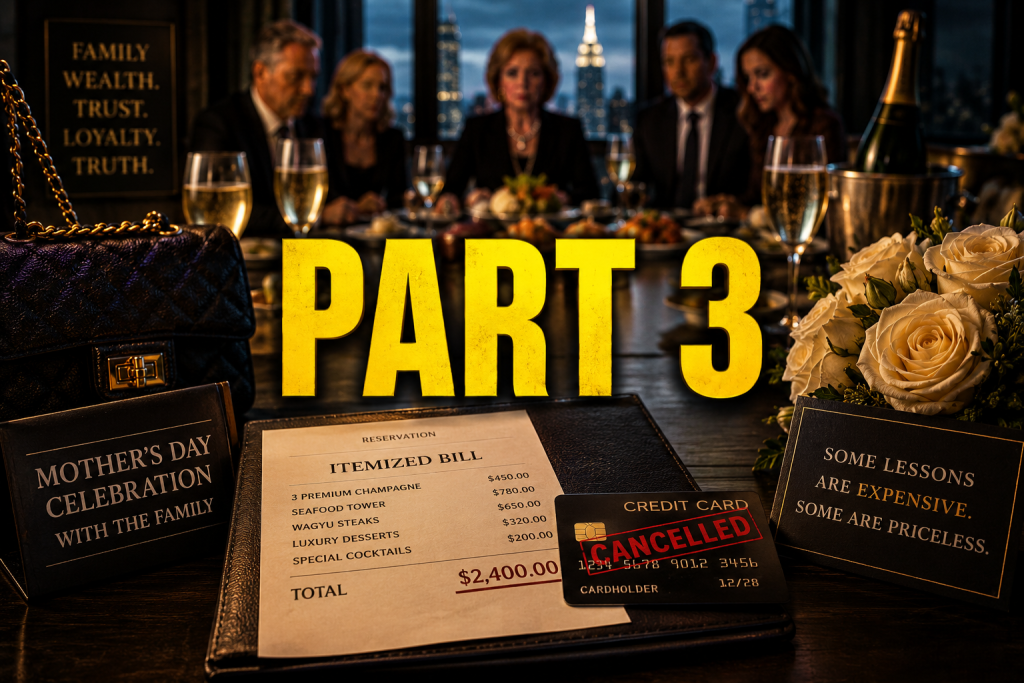
Three bottles of premium champagne.
Imported seafood towers.
Luxury desserts.
Handcrafted cocktails.
Fresh floral arrangements.
A celebration funded by someone they had deliberately excluded.
My mother stood the moment she saw me.
Relief washed across her face.
Not affection.
Not apology.
Relief.
The person expected to pay had arrived.
“Thank goodness,” she said. “Fix the card.”
No greeting.
No apology.
No acknowledgment of Lily.
Just a demand.
That was when I realized something.
My family had become so accustomed to my generosity that they no longer recognized it as generosity.
They viewed it as an obligation.
Something they were entitled to.
Something they believed would never end.
They were wrong.
The manager arrived carrying the itemized receipt.
The total exceeded $2,400.
My mother pushed the bill toward me.
“You’ll handle this.”
I picked up the receipt.
Then calmly calculated my portion.
Coffee.
Pastries.
Breakfast.
Lily’s pancakes from earlier.
Ninety-four dollars.
I placed the amount on the table.
The room froze.
“What is this?” my mother asked.
“My bill.”
Confusion spread around the table.
Then panic.
Because suddenly everyone understood.
For the first time, they were responsible for themselves.
No rescue.
No bailout.
No family bank.
No Emma.
Then my mother made a mistake.
A very big mistake.
“You owe me,” she snapped.
The room became silent.
I looked directly at her.
Then asked the question nobody expected.
“For what?”
She opened her mouth.
Nothing came out.
Because there was no answer.
Parents deserve love.
They do not deserve unlimited access to their adult children’s finances.
Family deserves respect.
It does not deserve ownership.
And children deserve protection.
Especially when the people hurting them share your last name.
Then something unexpected happened.
My elderly aunt, who had been quiet the entire afternoon, spoke up.
“Actually,” she said softly, “there’s something everyone should know.”
The room turned toward her.
Including my mother.
My aunt looked nervous.
Then she revealed a secret she had carried for years.
A secret involving family property.
A hidden inheritance dispute.
And a change made to my grandmother’s estate documents shortly before her death.
A change that explained why Lily had always been treated differently.
A change that would eventually involve lawyers, probate court, property records, and a family trust worth far more than anyone at that table realized.
Suddenly Mother’s Day brunch wasn’t about hurt feelings anymore.
It was about money.
Inheritance.
Control.
And a secret someone had spent years trying to bury.
The truth would eventually destroy relationships, trigger legal battles, and expose years of manipulation.
But it all started with one text message.
And one little girl who finally helped her mother realize that protecting family should never come at the expense of protecting your child.
